|
Maximum Brain Dysfunction
EVERYBODY is in a whole
lot of trouble. People all over America are losing their car keys and
even forgetting their own telephone numbers, to say nothing of their zip
codes. A man we know put an empty shredded wheat box in the refrigerator,
and a lady in Tacoma asked her husband to pick up a tune of canna fish
on his way home. Three out of four diners in the fanciest restaurants
move their lips while figuring out fifteen percent of $48.83, and some
of them will find that they have left home without it.
So what, you say? Ha! So you obviously don't
know the first damned thing about minimal brain dysfunction, that's what.
We do know the first damned thing about that dreaded disorder,
and a supremely damnable thing it is: there are at least ninety-nine
separate and distinct symptoms of minimal brain dysfunction! You
are probably suffering from about thirty of them right now. And here's
yet another damned thing: minimal brain dysfunction is itself only one
of a whole host of "learning disabilities" that educationistic
psychologists have somehow managed to discover in the last fifty years
or more. And the damnedest thing of all is that when we ask those educationists
why their victims are so ignorant and thoughtless, they say that they'll
try to puzzle it out if we'll just give them more money, and we give them
more money, and they hire each other as consultants, and the consultants
duly discover yet another, hitherto unsuspected, learning disability.
So we were recently appalled, but hardly
surprised, by a fat bundle of guidelines called "Michigan Special
Education Rules." It is only in theory a separation of goats
from sheep; in practice it is a charter of perpetual employment
for goatherds. Its covert assumptions make the Doctrine of Innate Depravity
look like the sentimental dream of some bleeding-heart liberal, for the
Doctrine of Universal Impairment has no counterpart of the Operation of
Grace. It looks instead to the Implementation of Grants.
The Michigan Rules include: "R 340.1706
Determination of emotionally impaired." Stubborn neurotics that we
are, we just couldn't resist the risk of self-knowledge that offers itself
in any list of symptoms. Sure enough, the very first symptom of "emotionally
impaired" was: Inability to build or maintain satisfactory interpersonal
relationships within the school environment.
A double whammy! That is precisely
the environment within which every member of our staff has plenty of trouble
with those very relationships. Furthermore, since literacy has recently
been discovered--within the school environment--to include lots of
that interpersonal relation stuff, we had to find ourselves illiterate
too!
Reeling with the shock of recognition, we
managed to puzzle out, by lip-movement and subvocalization, the second
symptom: Inappropriate types of behavior or feelings under normal circumstances,
presumably still "within the school environment," although whether
that is a "normal circumstance" is worth some thought.
A mystery. What types of behavior
and feelings are there? Which circumstances are normal? Is it normal
or not, under this very circumstance, to feel, as we in fact do, a feeling,
if not a type of feeling, remarkably like another symptom of "emotionally
impaired" in Michigan? General pervasive mood of unhappiness or
depression.
So. When it's three o'clock in the morning
of the dark night of the soul, don't go near the guidance office. There
will be no waiting around for Godot in the hallways, no hesitation at
the turning of the stair.
And the thought of all that "school
environment" where all the little Donnies and Maries are all agog
about Be All That You Can Be Week, and where "to be or not to be"
is definitely not the question, brings on the fourth symptom of
"emotionally impaired": Tendency to develop physical symptoms
or fears associated with school or personal problems.
Right. Absolutely right. Bellyache and vertigo.
And fear. Fear and trembling. The simple truth must out: We are emotionally
impaired in Michigan. A classic case.
Who shall stand when the Impairment Inspector
appeareth? Who shall abide the day of the Disability Determinator's coming?
Not we, surely; and, whether out of some inappropriate feeling or this
pervasive mood of depression, we're beginning to have some dark suspicions
about you. We can see you, sitting there in some appropriate type
of behavior, smugly congratulating yourself on all your swell interpersonal
relations, and wallowing in your pervasive mood of jollity, without even
a touch of heartburn. Well, just you read this little codicil to the Four
Symptoms:
The term "emotionally impaired"
also includes persons who, in addition to the above characteristics,
exhibit maladaptive behaviors related to schizophrenia, autism, or similar
disorders. The term "emotionally impaired" does not include
persons who are socially maladjusted unless it is determined that such
persons are emotionally impaired.
Well, at least you don't have to worry about
being found emotionally impaired just because you're socially maladjusted,
unless you are found emotionally impaired because of certain maladaptive
behaviors that have brought you into your social maladjustment. When just
about all of us are normally impaired, your sanctimonious unimpairment
is about as maladaptive as you can get. And forget about trying to convince
us that those behaviors of yours are not related to schizophrenia or autism.
Big deal. What about those "similar disorders"? Do you have
any idea how many of them there are? All in all, you're damn lucky
to be living in a country that still has to put up with all sorts of deviants.
In some countries, those maladaptive behaviors related to similar disorders
could get you shipped off to live in some very cold place where you'll
probably end up eating your shoes.
It will not surprise regular readers that
all this determining is done by members of the Affective Functionary Faction,
government agents who keep watch over how people feel. In Michigan:
The emotionally impaired shall be determined
through manifestation of behavioral problems primarily in the affective
domain, which adversely affect the person's education to the extent
that the person cannot profit from regular learning experiences. . .
.
The wonderful thing about that Affective
Domain, and what makes it both the Lotus Land and the Happy Hunting Ground
of educationists and other pseudo-scientists, is that there is no Bureau
of Weights and Measures in that fair land. To weigh, to count, and thus
to find wanting, are the appropriate, normal, and profitably adaptive
behaviors of those whose greasy thumbs are on the scale.
Cardinal Richelieu, who was a member of
an Affective Functionary Faction in his time, knew how to determine maladaptive
behaviors too. "If you give me six sentences written by the most
innocent of men," he said, "I will find something in them with
which to hang him." What can it mean for our times that a wily conniver
of the bad old days suddenly sounds so refreshingly honest?
They Also Serve
Who Only Look for Work
THIS isn't going to
be easy, so try to pay attention. We are about to quote from a poopsheet
(what a splendid term!) called Bulletin on Public Relations and Development
for Colleges and Universities. The Bulletin is quoting,
with approbation, Ivan E. Frick, president of Elmhurst College in Elmhurst,
Illinois. Frick will be quoting, also with approbation, Cohen and March,
who must be members of the educationistic-administrative mutual approbation
complex. Here we go:
Presidential leadership is always needed
to get a college of any size to move and that task is seldom easy. Cohen
and March did a study of leadership among college presidents and developed
a theory . . . they called "organized anarchy." They said:
An organization is a collection of choices
looking for problems, issues and feelings looking for decision situations
in which they might be aired, solutions looking for issues to which
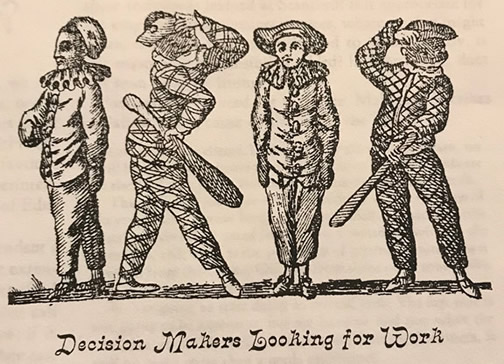
there might be answers, and decision makers looking for work.
There is considerable truth in this. An
example is when one prepares a case statement for a capital drive. Establishing
the case is not a simple process; its path is not linear, that is a
straight line from one agreement to the next one. The process is always
filled with a tremendous amount of ambiguity.
It is kind of Frick to explain the meaning
of "linear," although his explanation does leave us to wonder
whether that path from one agreement to the next might perhaps be a crooked
line. But a crooked line is still a line, and so Frick must be
saying that there is no line of any kind that leads from one agreement
to the next. That would certainly make sense, allowing for a tremendous
amount of ambiguity, of course, to anyone who has ever noticed the doings
of educationistic administrators, but it's unusual for a college president
to put it in writing.
And it's kind of Frick--ah, what a teacher
he must have been before he was dragged from the classroom into the thankless
prominence of presidency--to provide us an honest-to-goodness example
to help us understand that "considerable truth" in Cohen
and March. We do have to confess that the really heavy thinkers, like
Heidegger and Cohen and Hegel and March, are way over our heads. If it
weren't for Frick's illuminating example, we would probably never have
been able to understand why solutions would want to go looking
for issues that might already have perfectly good answers of their own,
unless they (the solutions) wanted, most uncharitably, and, one might
well say in this context, quite contrary to accepted principles of academic
collegiality, to replace them (the answers) with themselves (the solutions),
thus leaving them (the answers) nothing more than disembodied shades flitting
through the gloomy nether world of decision situations, looking for whatever
issues the solutions might have spurned, because they (the issues) were
not the kind to which there might be answers, the very kind for
which they (the solutions) are looking. We wouldn't even have been able
to figure out whether those issues for which solutions are looking are
the very issues that are themselves looking, along with feelings, for
decision situations. But now, thanks to Frick, everything is perfectly
clear. Only a bona fide college president, by gosh, could have
detected and revealed that much considerable truth.
Ivan Frick is not the only college president
quoted by the Bulletin on etc. etc. (You can get your own copy,
if you like, from Gonser Gerber Tinker Stuhr [whatever that, or they,
may be], 105 W. Madison, Chicago 60602.) We also get to hear from Dan
C. Johnson, of Mount St. Clare College in Clinton, Iowa. He tells us that
"there are few, if any, institutional activities which cannot be
enhanced by presidential presence."
Yeah, sure. The enhancing presidential presence.
Let us be thankful that classroom teaching is at the bottom of any administrator's
list of "Institutional activities" and thus the least likely
to be enhanced by the presidential presence.
Missing Linker?
SPEAKING of decision
makers looking for work, we suspect that we have discovered a genuine
linker, one of those erstwhile change-agents turned ex-facilitators about
whom we warned you. He is Terry McHenry, whose title would make a Byzantine
emperor's favorite eunuch sob with envy. McHenry is Assistant Superintendent
for Business Services for the County Office of Education in Santa Clara
County, California.
Right at the top of its front page, the
"Superintendent's Bulletin" admits that McHenry has completed
"the extensive nine-month Sloan Program offered by the Stanford School
of Business." (For educationists, anything that can be knocked off
with a little inservicing is intensive; if it takes a little more
time, and a lot more money, they call it extensive.) Now, McHenry
"has taken on the added responsibility of coordinating all planning,"
and "he will be using the techniques learned at Stanford and applying
it [sic] to marketing and managing the various services districts
require."
Well. Of course. We do have some grasp of
planning coordination, which involves not mere planning, but the
far subtler arts of planning to plan, and planning whether to plan.
That might be what Cohen and March should have meant by "issues and
feelings looking for decision situations in which they might be aired."
But the rest of it is murky. What does one do when he manages a
"service districts require"? Does he order paper towels according
to those techniques learned at Stanford? Is it appropriate for the employee
who manages services, whatever that might mean, to market
them as well? And to what, exactly, is this mysterious responsibility
added? In short, what does this man do for a living?
Fortunately, we need not speculate. McHenry
describes his labors in the cause of the life of the mind:
Districts are our clients. Under the new
planning program, we will hopefully do a better job of determining what
the needs are in the field and, given, how we can meet those district
needs.
This will be a lot more than just asking
a simple question of do you want a certain kind of service, which is
what they (the districts) have been asked before. It is a matter of
what is the potential, and, what is the possibility of getting resources
for it--either from the County Office or from some other source. We will
be looking at the whole scenario.
We are going to start doing an overall
look. The first year is not going to be extensive, but we have to find
out what the attitudes are out there for the need and provision of services.
It will be much more than a needs assessment.
Aha! The whole scenario. The potential.
The resources for the potential. More, much more, than a mere needs
assessment. But gently! Nothing extensive. The needs in the field will
keep. First you have to start to find out those attitudes
out there, the attitudes for need and provision. (Could there be
any against?) Not an easy job. Might take years. None of
them extensive.
So what did we tell you? The man must be
a linker!
Please don't laugh at a linker. Without
linkers there couldn't be any county superintendents, who can hardly be
expected to superintend the district superintendents all by themselves.
And those superintendents need linkers, both to link with the county
linkers and to look at the whole scenario in superintending the attitudes
for need and provision among the principals and their linkers.
And all of those people need offices, and secretaries, and Mr.
Coffee machines. Quality education doesn't come cheap, y'know.
Kollege Kredit Kourse No. 6291
[Proposed for Recreation Majors and Masters
in Recreation and Leisure Services at Central Missouri State U., Warrensburg.]
Designed to acquaint the practitioner/student
in recreation and related fields with the philosophical foundations of
leisure counseling. The student will explore concepts, theories, and techniques
in leisure counseling with emphasis on facilitation.
Teratology
HERE is a blurb from
a brochure promoting a ‘Celebrate Literacy' workshop sponsored by the
River Falls Area Reading, Council in Hudson, Wisconsin. It explains a
lot:
Dr. Robert A. Pavlik is chairman of the
Reading Department at Cardinal Stritch College in Milwaukee, Wisconsin.
He is also a language consultant for the Scott, Foresman Publishing
Company. In his capacity as a language consultant, he inservices authors
and editors on how to write textbooks for minimum student comprehension.
And here is an assessment of the conditions
that prevail at the Santa Cruz campus of the University of California.
The assessor is Chancellor Robert L. Sinsheimer:
The absence of a functional structure
coupled with stress on being different that encouraged each faculty
member to pull his or her own way effectively locked the campus into
a state of dynamic immobility.
Neither can his mind be thought
to be in tune, whose words do jarre; nor his reason in frame, whose
sentence is preposterous.
The Underground
Grammarian
Published monthly, September to May
R. Mitchell, Assistant Circulation Manager
Post Office Box 203
Glassboro, New Jersey 08028
|