Sayings Brief and Dark
In accordance with their textbooks, they
are always in motion; but as for dwelling upon an argument or a question,
and quietly asking and answering in turn, they can no more do so than
they can fly. . . . If you ask any of them a question, he will produce,
as from a quiver, sayings brief and dark, and shoot them at you; and
if you inquire the reason of what he has said, you will be hit with
some other new-jangled word, and you will make no way with any of them.
Their great care is, not to allow of any settled principle either in
their arguments or in their minds, . . . for they are at war with the
stationary, and do what they can to drive it out everywhere.
NO, that is not
an extract from a report of a convention of curriculum facilitators, or
a tale told out of school by someone who escaped from a teacher academy
with all of his faculties intact. It is--and we always find this sort of
thing refreshing--a passage from Plato, who never even heard of educationists,
and who never had to. He knew the archetype, the ideal, of which our bold,
innovative thrusters are just local and ephemeral appearances--just our
bad luck.
The speaker is a certain Theodorus, and
he is talking not about educationists but about some Ephesians who have
adopted the notion that knowledge is perception and, therefore, as mutable
and diverse as the world and different for every perceiver. And it is
because they deny the possibility of permanent and universally pertinent
principle, or of any "truth" that might be supposed to exist
whether anyone perceives it or not, that they are said to be "at
war with the stationary."
We don't know much philosophy
around here, but we sure do know a neat idea when we see one, and that
is one neat idea. It means, among hosts of other neat things, that we
are OK, that we don't have to know much philosophy around here.
We can perceive just as well as the next monthly. And when you come to
think of it, or even when you don't come to think of it, you can
easily perceive it as a really democratic idea, the very idea we
need to prove the worth of rap sessions in which eight-year-olds can decide
all about abortion and alternative lifestyles and which passenger to throw
out of an overloaded lifeboat.*
Theodorus, however, took no harm greater
than exasperation from his visit to Ephesus. He was not obliged by law
to spend twelve years among the practitioners of quality philosophy. Nor
did he enroll in an Ephesian equivalent of a teacher academy, so that
he might experience slogans and incantations relevant to outcomes-based
instruction modalities and enhancement facilitation.
We, on the other hand, cannot go home. Athens
is fallen, and Ephesians peddle tacky souvenirs among the ruins. There
is no dwelling upon argument, but only the rap session, no quietly asking
and answering in turn, but only privileged self-expression in the recitation
of the latest notions.
We are led into these melancholy reflections
by a sad and exasperated letter from a faithful reader. He is in the school
business, but is obviously still a thoughtful person.
He was filling out yet another of those
countless and mind-numbing forms that educationists, given sufficient
funding, of course, dearly love to cook up and send around. (They call
that "research," and the "answers"--usually nothing
more than choices checked off by bored and angry people justifiably thirsty
for revenge--they call "data.") The poor man, who is not an educationist,
but a teacher, the lowest rank there is in the school business, read these
words of wisdom from his betters:
As the individual staff member considers
a program of self-improvement, attention should be given to the ability
to impart knowledge.
Something must have snapped in his mind.
We'll never know exactly what caused it. Maybe it was that lofty Passive
Imperative: "Attention Should Be Given." Maybe it was the realization
that he, a mere individual staff member, couldn't even identify
those of his colleagues who might be of the other kind. In any
case, he did what you are never supposed to do in the school business.
He looked at one of those sayings, brief and dark, and actually thought
about it. Should that sort of anti-social behavior become common in our
schools, there would be an end to educationism, which depends absolutely,
like any other cult, upon the credulousness of its adherents, and which,
like any other cult, fosters credulousness by giving catechism the name
of "education."
The brief, dark saying that caught our correspondent's
mind was that pious and oft-intoned mantra: "The Ability to Impart
Knowledge." How he thought about that, we can't tell you in detail,
but in principle we can tell you, because the principles
are stationary. He dwelt upon the question; he did not appreciate it or
interact with it. He asked and answered in turn; he did not rap. He inquired
the reason of what was said; he did not relate to the reasons for
saying it.
He put questions like these: Does knowledge
need imparting, whatever that is, or would telling be enough?
When knowledge is told by stones and stars, who is the teacher, and in
what statements can we describe the knowable properties of his "abilities"?
If the imparting of knowledge is the telling of what is so, who can lack
that ability, except the insane, the imbecilic, the comatose, the irretrievably
deluded, or the pathologically mendacious? If, however, that imparting
of knowledge is something other than the telling of what is so,
what, exactly, are its properties? Can we consider the "ability"
to do it, or judge whether it ought to be done, without knowledge
of its nature? Is knowledge not that which needs beholding rather than
assertion, and is the habit of diligent inquiry not the parent of beholding?
As to the worth of teachers, and especially teachers of teachers, ought
we not to judge of their habits and ways of inquiry instead of their self-proclaimed
and utterly unintelligible "ability to impart knowledge"?
Still, as at least one man we know will
surely testify, you can learn a thing or two--well, not from,
exactly, but because of those people. Maybe that's the secret of
a good teacher academy, a place where the students, sitting still
and thinking, could just observe the educationists leaping from
tree to tree in their natural habitat.
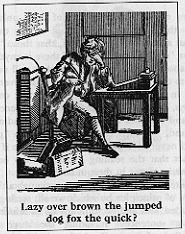
To be to Some chewed Books
Tasted Are Swallowed to digested,
and Others be, and Some be Few
NEVER spoken truer were
words. And out are to quickly some spat be. Unfortunately, however, the
natural good sense which instructs even very small children to spew noxious
substances clean across the room is suppressed in the schools as anti-social
and little conducive to the self-esteem of the teachers. The wretched
little tykes, once the iron door of the schoolhouse clangs shut behind
them, are required by law to swallow everything fed them by the
bold, innovative thrusters who make up the ever-changing menu. Peanut
butter guacamole yesterday, potato chips in aspic tomorrow, but never
a smidgen of jam today.
Nevertheless, however improbable and nauseous
their concoctions, it is usually possible to figure out what it is that
they either imagine or pretend that they will accomplish. But now, in
an unbook called Expressways, a sixth-grade "reading"
text, we have a disgusting mess of unidentifiable substance whose supposed
purpose we cannot even begin to guess.
It pretends to be an exercise in "correcting
word order," and begins by asserting that "word order affects
the meaning of a sentence," as some precocious (and thus, as you
will see, disruptive) children will have noticed even before they reached
the sixth grade. The exercise asks the students to do something about
some supposedly garbled sentences. Some of them actually are garbled:
magician a Merlin was
Arthur enchanted an stone of pulled
out sword of
Not quite as much fun as a barrel of monkeys,
perhaps, but close. Even the dullest students should be able, as instructed,
to "rewrite each group of words to make a clear and sensible sentence."
But why, dammit? Why?
Is this what those educationists mean by
"problem-solving"? Do they imagine, or pretend, that a garbled
sentence is a "problem" for which all readers must be prepared
lest they fail to comprehend deliberate distortions? Is it some "life-skill"
enhancement intended to insure that the students will still be able to
check the right boxes on comprehension tests when all the printers have
gone mad? Are students, in fact, likely to write such garbled sentences?
To make a bad thing worse, the concocters
of this silliness can't even garble skillfully. Having vouchsafed
that "word order affects the meaning of a sentence," and having
asked that students assemble "clear and sensible sentences"
from "groups of words" that could never occur naturally, these
reading experts proceed to dream up "problems" of this kind:
the knights made out of marble sat
at a round table
persons in distress rescued the knights
some knights went in search of holy
objects on quests
Try now to imagine the plight of those unlucky
sixth graders--there are plenty of them--who can see, as anyone but a reading
expert might, that those "groups of words" are "clear
and sensible." If there is anything at all "wrong" about
them, it is only that they will not win approval from the teacher, who
can easily discover, by looking it up in the handy teacher's guide that
comes with Expressways, that those clear and sensible sentences
are not the clear and sensible sentences that the reading experts
had in mind, not the "correct" solutions to "problems"
that would never have existed in the first place if it weren't for the
fact that the reading experts always need tricky new gimmicks to put in
their unbooks.
The exercise pretends to ask a question
about grammar, the system of principles by which we all, sixth-grade children
included, can and do form any of an infinite number of possible sentences,
including the three supposed "problems" cited above. But in
fact, it asks a question to be answered out of that minimal kind of reading
that is really nothing more than the reception of communication. And,
probably for the remediation of those obstinate students who persist in
suspecting that it is by form, not content, that a sentence is a sentence,
there is a postscript to all this absurdity. It's called "Interaction":
Make up your own scrambled sentences
about how Merlin could help you. Have a classmate unscramble your sentences.
It's not enough, you see, although it is
required, that educationists commit nonsense. They are, as they are always
saying, such giving and sharing people. And when they commit nonsense,
everyone commits nonsense.

The Steaming Bird
This course is divided into two component
parts: college coursework and laboratory. The college student is referred
to as a Teacher Assistant whose principle [sic] task is to assist
classroom teachers so as to gain insights into the many functions of
the secondary school. Some suggested experiences for the Teacher Assistant
are as follows:
EVERY once in a while,
usually right around Turkey Time we like to bestow the prestigious order
of the Steaming Bird upon an especially distinguished member of Glassboro's
celebrated, Division of Professional Studies. But it's hard to
choose. So many of them are so distinguished as to be utterly beyond our
powers to distinguish.
No matter. Our trade union tells us that
all faculty members deserve to be equally distinguished in every
way, and with like egalitarian selectivity, we just reach into out file
of Equally Excellent Examples of Professional Educationism and
come up with a winner. And sometimes we just throw them up the staircase.
This year, our deliberations have led to
the selection of one Miriam Spear, the author of the cited passage, and,
we guess, a professional in the provision of experience's
that lead to the gaining of insights. (It is never easy for nonprofessionals
to figure out exactly what it is that they do over there; mere
"teaching," which many amateurs might more or less recognize,
they seldom propose.) She is surely describing some "course,"
but we can't tell you its name; she doesn't give it. We are glad to see,
though, that it is made up not merely of parts, which even the bumblingest
amateur might manage to achieve, but of the ever so much more state-of-the-art
"component parts."
After that colon, there follows a long list
of chores, which the "college student" (the very kind
we have, by golly!) will surely be persuaded to look upon as
"laboratory." Language does the trick. If you simply call a
student a student, you can never be a distinguished educationist. A mere
student will probably notice in just a few weeks that the supervision
of corridors, buses, and cafeterias is an utterly mindless and unenlightening
drudgery as well as a nasty kind of involuntary servitude. And, unless
he has been properly re-oriented out of the amateurish notion that teaching
and learning are works of the mind, he might actually decide
to become a student of something rather than a teacher-trainee,
thus diminishing the cost-effectiveness of the whole Division! However,
if the same student is grandly "referred to as a Teaching Assistant"
he may imagine that such dismal duties are really "experiences"
leading to "insights." He may come to believe, as well, that
pushing the buttons of audio-visual gadgets and running off dittos of
"learning materials" are really scientific enterprises,
meticulously designed and scrupulously conducted, in that laboratory
component part of this neat course in professional insight-gaining.
As to the other "component
part," here called "college coursework," Miriam Spear is
silent, but not strangely silent. Of the twenty-two entries that follow
the colon, all but the last are either house-keeping chores, obscure generalizations
like "Assist Department Chairman," or "Work with a club
or other activity groups," or weird stuff like "Shadow Study."*
Insights into functions, the many, many functions. The last entry says:
"To be of service to the school in exchange for a learning experience."
Well, with a laboratory like that, who needs any college coursework
component part?
Educationists are pleased to imagine that
experience is learning. Since they "read" only approximately,
they suppose that Poor Richard was commending experience in the
celebrated adage, rather than revealing it the teacher of last resort
and the fool's last chance. Experience by itself can teach only knacks,
which may indeed save a fool, but will hardly make him wise, or even a
teacher. It is thoughtful, orderly discourse about experience that
leads to understanding. Lacking that, we can't even be sure of learning
the knacks that experience can teach.
You can test that for yourself by contemplating
the cited passage. In spite of what you think, Spear has been a professional
for a long time, and that is not her first try at prose.
And furthermore…
WE had fewer testy responses
than expected to "The Children of Perez." Two readers wrote
to say that such matters were beyond the scope (and they may have meant
beyond the understanding as well) of this journal.
But the dangerous doctrines of a Perez,
and the ideology out of which they flow, are protected from critical analysis
in our schools, which think it good to persuade all the children into
an undiscriminating "appreciation" of all known cultural heritages
and "alternative lifestyles," without consideration of their
implicit principles or lack of them. We approach that time when the educationists'
already traditional neglect of "mere facts" like the provisions
of our Constitution will be justified anew by the fact--which they won't
call "mere"--that somebody might be offended by those provisions.
As Perez now is.
Such a concern is not "beyond
our scope," whatever that may be. Nor is it beyond anyone's scope.
And that brings us to "understanding."
The search for understanding is the purpose
of the critical examination of language. A scrupulous attention to mechanics
and convention is only a paltry fussiness unless it reveals how
and why those who seek admission to the greater mysteries will advance
all the better through practice in the lesser. We want the schools to
teach the skills of language not because that will make the students
more genteel, but because it just might make them more thoughtful, and
thus more likely to recognize and repudiate public displays of ignorance
and unreason. Such displays, often further tainted by pandering mendacity,
are the very substance of our politics and the chief agents of mindless
factionalism. We are not going to wait until our Perezes dangle their
participles. Their words are enough. To inquire into them is our
right and duty.
A Brief Note from Central Control
We have to ask our readers' indulgence.
This issue is late, and all issues from now until May will also be late.
Several indispensable members of our staff, the typesetter, the printer,
a few untitled gofers, and even the assistant circulation manager, were
led away into ineptitude and disorder a couple of months ago. And it is
only now, as October draws to a close, that they are beginning to drift
back to work, more or less in their right minds.
Neither can his mind be thought
to be in tune, whose words do jarre; nor his reason in frame, whose
sentence is preposterous.
The Underground
Grammarian
Published monthly, September to May
R. Mitchell, Assistant Circulation Manager
Post Office Box 203
Glassboro, New Jersey 08028
Annual subscription: US & Canada, $10;
others, $14.
_________
* They actually do this in the schools.
It's called the Lifeboat Game, which proves that school has its lighter
side. The dull labors of math and grammar are offset by playful interludes
of childlike chatter as to who shall live and who shall die.
The game provides a dramatis personae clearly
differentiated by "socially significant" attributes: age, sex, ethos,
calling, and other such contingencies by virtue of which a person is also
a local and temporal manifestation. This is not one of the contexts
in which educationists choose to warble paeans to "the uniqueness and
absolute worth of the individual." (Inconsistency troubles them not at
all; they are at war with the stationary.) In this case, the verdict must
be relevant," conducive to "the greatest good for the greatest number,"
and the exclusive focus on accepted notions of "social usefulness" assures
that a decision will be made. Another kind of inquiry--whether
it is better to do or to suffer an injustice, for instance,
or whether the common good is more to be prized than the good--would
preclude decision and spoil the game, sending all the players back to
the tedium of math and grammar. Schoolteachers, in any case, are usually
kept ignorant even of the possibility of such inquiries, but they
have been told all about self-worth and how to enhance it.
The children who "play" the game usually decide
to dump an old clergyman, a man who is supposed to be prepared for that
sort of thing--being fed to sharks by a committee of
children, that is. A busty young country-western singer will be preserved.
She has many long years ahead of her in which to maximize her potential
and serve the greatest good by entertaining the greatest number. And she
is supposed to be prepared for that sort of thing--being
elevated to wealth and power by a very large committee of children.
What a pity that Himmler and Goebbels and all
that crowd are dead. They'd make really neat resource persons for the
Lifeboat Game. Well, there's still Rudy Hess, and we might even find Mengele.
back
Some of the entries are sentences,
some not; some of the latter are capitalized like titles, some are not.
Such inconsistencies are remarkably frequent in educationistic writing.
It is as though they can not help themselves, as though they so deeply
hate ordered discipline and logical regularity that they can not bring
themselves even to seem regular and disciplined, lest their prose
admit principles they prefer to deny. back
|